

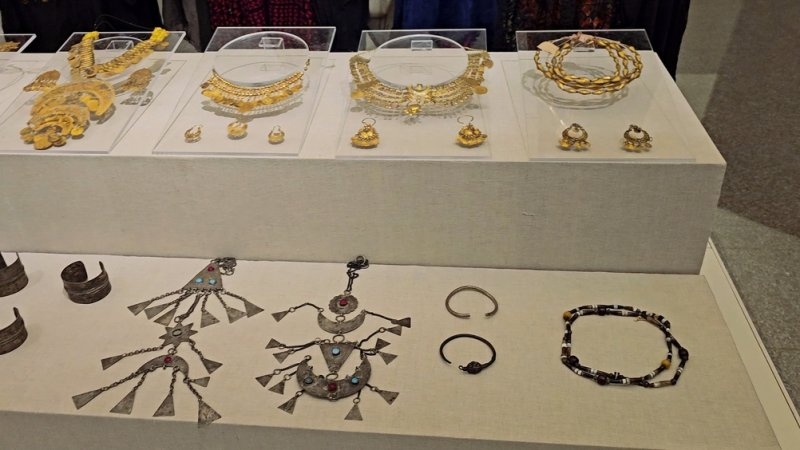
Whether a simple trinket, a charming protective artifact, or ornate gold adornments, Egyptian ornaments have a very inspiring ability to immerse us in that long-lost culture.
Through their strong symbols, rich colorations, and intricate craftsmanship, Egyptian designs continue to be adopted in modern jewelry.
Jewelry in ancient Egypt was worn by women and men. From finds such as those discovered in pharaohs' tombs, we can clearly see that jeweled items can tell us who is who in Egyptian society, whether being royalty or common folk, and whether they are adults or babies. Nevertheless, precious materials such as gold, silver, or emeralds should indicate wealth and also have other purposes—those of belief, religious significance, and protection.
Protection was most essential of all. It was considered that amulets had the ability to ward off dangers threatening people; these people then wore them and placed them with their dead pharaoh to show belief in protecting the spiritual dimension after death.
Materials for use within ancient Egyptian accessories were more of what is now known to be best—gold was widely used for its radiant appearance and its inability to rust; other items that people widely wore also contained silver, bronze, faience, and other gems, such as:
Whatever the material, whether rich like gold or a simpler stone such as carnelian, all ancient Egyptian accessories had one link in common, and that was trade, which indicates that other countries traded with the Egyptians and these gave them their gems.
Egyptian adornments were very often decorated with symbolic figures relating to religion, existence, royal life, etc., and were all very important in day-to-day Egyptian life. It is also quite common to find a scarab beetle within the jewelry of a dead pharaoh.
What were once simple pieces are now a very fashionable statement about Egyptian culture; for instance, a plain ankh pendant or a ring adorned with a scarab beetle shape is a modern-day symbol associated with ancient jewelry, as are lotus or snake designs.
The diversity among Egyptian accessories simply indicates just how important adornments were in everyday life, as they can all have an aspect of ritual or daily use, such as antique Egyptian jewelry for women, including bracelets, rings, golden earrings, and Egyptian headbands, etc. Or how precious men wore them in terms of a golden chest plate.
Other than accessories like bracelets, there is also the Egyptian broad collar made out of colored bits of stone/glass and a very well-designed ancient Egyptian necklace that, if of high worth, has precious jewels/stones set within, not unlike similar necklaces being worn today by modern pop stars, etc.; however, just as simple jewelry, so are those of Egypt's most honored, as they are very plainly adorned or have precious jewels added, so showing how varied all the accessories/adornments available are.
Ancient jewelry for women can range from an ornate gold pendant to something like a solid gold necklace—an incredible show of craftsmanship from what was once to become our modern Egypt. Likewise, it is possible to see that there have been men with great interest in adorning themselves, from pharaohs down to common workers, so why does this give us any clues towards who they are? We know this because each of the ornaments, or ornaments that a person had in their sarcophagus, was to signify that specific person on earth.
The beauty of this artifact from the tombs of Egypt is evident when one begins to observe how much love was expressed through this small addition to Egyptian society.
The colors of the jewelry were obviously important, especially when using precious jewels like carnelian or lapis lazuli, but these types of jewels were only obtained as Egyptian people had many trade deals in and outside of the lands of Egypt, which helped show all those interested the wide networks that existed not only within this country alone but far outside, also revealing the true value that these accessories must have had.
Not every jewel identified as an Egyptian antique simply because it wears a symbol such as an ankh or a scarab does not immediately become part of authentic Egyptian accessories. Jewelry items such as the scarab or ankh may belong to a piece that, although it could look rather antique, might be a new product of jewelry.
The authenticity of a piece of jewelry is discovered through a variety of means: its wear and tear may display age, its style the historical era it belongs to, its inscriptions/symbols show a name or religion or devotion that belongs in history, and its original burial place, if known, and how many times the jewel has travelled since antiquity may contribute to finding its past more clearly, also giving some clues on its value.
Modern designers still gain their inspiration from what the people of old wore; a very common example is the reintroduction of accessories such as the scarab beetle, lotus flower, etc., in modern accessories, and of course, this may be found in jewelry too, such as earrings or necklaces of this style worn nowadays and still remain a popular item, as these creations truly express one particular historical context of culture from long ago and remain the inspiration of so many people today who still value these unique traditions deeply.
A testament to skilled craftsmanship and artistry, ancient Egyptian jewelry is a fascinating subject with immense historical and cultural relevance. The materials employed offer insights into the state of the Egyptian economy and foreign relations, while the symbolic meanings reflected in Egyptian design are a captivating glimpse into that nation's deeply spiritual beliefs about the meaning of earthly existence and a better hereafter.
Whether it is a striking, ornate, ancient Egyptian necklace, colored amulets, or jewel-laden broad collars, each individual piece has something significant to convey and to express. The timeless appeal of Egyptian adornment speaks volumes about this enduring inspiration of design.
The jewelry made in Egypt could be used to adorn the body, offer protection, and represent religion and a position within society. Other jewelry was created for use in rituals and to be placed with the dead, so it had both a practical and symbolic value.
Jewelry was worn by all, from adults to children. Archaeological discoveries indicate that jewelry such as beads and amulets could have been worn by children as a form of protection and decoration. Gold was used extensively in ancient Egyptian societies.
Gold was a significant material used in Egyptian jewelry, mainly due to its bright and radiant look. It has always been looked at in conjunction with wealth and divinity, which gave the impression that only the royals and the powerful should be rewarded with gold; it also served in the adornments of deities and was utilized by talented artisans to produce regal ornaments and items.
Pectorals are ornaments placed upon the chest and often covered in jewels, beads, and colors such as gold. Most pectorals had religious or royal images on them that involved gods and symbols.
Yes, a few Egyptian jewelry designs still echo the motifs in ancient designs. Such designs and jewelry, such as an ankh, lotus, or scarab, would demonstrate a thought in respect of the past of Egypt; they have not necessarily been reproduced in an identical context.
This content was created by AI