

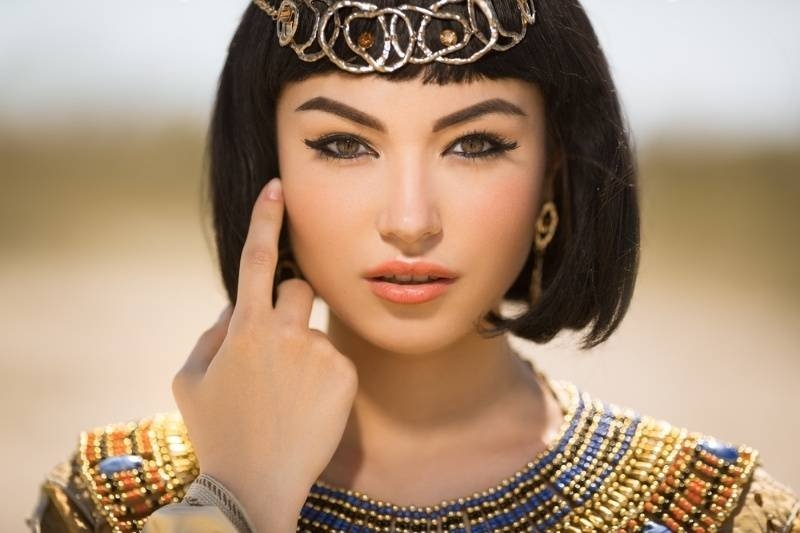
Painted eyes and braided wigs were more than just cosmetic flair in ancient Egypt. Hair and Makeup in Ancient Egypt explores a culture where beauty rituals were intricately linked to religious practice, personal identity, status, and even death. In every social group – from priests and laborers to royalty and even animals – we discover how and why Egyptians applied cosmetic products to their skin and hair.
Through combs, razors, cosmetics, mirrors, and tomb art and texts, we catch a glimpse of a people for whom grooming was not simply an act of vanity, but a form of physical defense and spiritual service.
For survival in the hot and dusty climate of Egypt, personal grooming was paramount. Oils moisturized dry skin, shaved heads reduced lice, and tinted pigments reduced the glare of the intense sun around the eyes.
Appearance functioned as a social code, too. Well-groomed hair, a perfumed body, neat linen, and well-made cosmetics signified that an individual had the time, resources, and access to skilled labor, crucial in a society with rigid class divisions that set apart scribes, priests, officials, and royalty from laborers working the fields.
Both men and women sported adornments for their faces and eyes. Exploring Hair and Makeup necessitates examining as many grooming tools – from tiny stone palettes, reed applicators, and bronze mirrors to shell containers and alabaster jars found in tombs – as the cosmetic substances themselves.
Key cosmetic ingredients include galena for black pigment, malachite for a green hue, red ochre for lips and cheeks, and animal fats or plant oils for binding agents. Despite possibly being less sophisticated than their modern counterparts, the carefully compounded materials and precious vessels demonstrate that cosmetics were esteemed household goods.
The dramatic line encircling the eyes served several purposes: it accentuated features, mitigated the blinding glare of sunlight, and was also imbued with apotropaic properties associated with the Eye of Horus and health from a divine source.
Modern scientific analyses of some black eye paints have revealed trace amounts of lead, but in controlled and prepared doses, they may have had mild antimicrobial effects that the Egyptians themselves, without the tools of modern science, intuitively understood.
| Material | Likely use | Common evidence |
|---|---|---|
| Galena | Black eye pigment | Cosmetic pots and applicators |
| Malachite | Green eye color | Palettes and powdered residue |
| Red ochre | Lips, cheeks, and skin tone | Paint traces and mineral samples |
| Oils and fats | Skin softening and fragrance base | Jars, residue, and offering scenes |
The evolution of ancient Egyptian hair, be it the lock of a child, the crop of an adult worker, the intricate braiding of nobility, or the shaven heads of priests, reflected changes with age, occupation, social stratum, and ritual.
Hair shows that hairstyles in ancient Egypt could also serve as indicators of the owner’s access to resources. The efficient cut of a laborer served as protection against the heat, whereas the carefully coiled and braided Styles of the elite required the expertise of a wig-maker and considerable attention.
Shaving one's head was not a statement of modesty, but rather a practical method of protection against the pervasive summer heat and insects that plagued the arid region. Ancient Egyptian hairstyles incorporated elaborate wigs, usually fashioned from human hair, animal fiber, or a combination of the materials, into either tight curls, waves, or braids, each bearing their own special meaning according to what represented one's personal status, role in society, or participation in sacred events and festivities.
For example, banquets in depicted Egyptian artworks are graced with guests sporting slicked hair and aromatic cones atop their heads; the nature of which still remains ambiguous among scholars-was it some sort of greasy fat, or a symbolic representation of scent and freshness, or yet something other altogether? Depending on the setting of the visual in question and the particular epoch in which it was created, we will be able to find a number of interpretations!
A luxury grooming routine for the elite might include washing, shaving, moisturizing, accentuating the eye, styling the hair, and adding fragrance for a formal engagement or religious ritual. These practices went beyond mere personal vanity and established a link between a living entity and purity, Order, Fertility, and celestial Favor.
Skin Care in Egypt Was Primarily to counteract the ill effects of the hot, dry atmosphere; the application of skin lotions using the seed from plants such as moringa or Sesame oil in this process. Other materials, such as Honey and natron, were utilized as antiseptics in the medicinal practices; yet, the effectiveness and nature of this routine varied depending on one’s wealth and resources in Egypt.
In order to keep one whole and appealing throughout eternity, combs, razors, mirrors, cosmetic tools, and pigments are left to one’s remains. Templescenes also shed light on Egyptian practices as priests are seen shaving, cleansing, and perfuming themselves, just before they entered sacred territories. Statues of gods are bathed in fine substances and oils, and this reflects an analogous connection to the human body, where care of both the Divine and the human body goes hand-in-hand with Purity.
The reader must analyze the eye with royal status, priestly profession, child’s status, or ordinary household occupant to discern the significance of each grooming implement. Analyze where each artifact is situated: at a lavish feast, in the tomb with remains, or as evidence in ancient texts and medical documentation; these environments and contexts may shed additional information on how such an item was utilized in ancient Egypt. Separating materials as well as symbolic representations will be paramount in accurately portraying and understanding these artifacts.
Repeated observations in Egyptian iconography-whether it be eye paint, razors, combs, or mirrors-will attest to the everyday utility of such items and not merely their perceived opulence. So the challenge for any deep reading is to examine the part that each element played in constructing an Egyptian existence in life.
Hair and makeup rituals in ancient Egypt reveal an ancient society in which personal grooming both met a need and formed part of the very heart of the cultural spirit of the era. Ultimately, you discover that beauty in ancient Egypt was neither superficial nor a matter of simple indulgence, but in truth incorporates elements of science, religion, and aspiration into this living tapestry of Nile life.
Small pieces of Egyptian evidence, such as a humble pot of kohl or a humble comb, can, in fact, tell you more about the heart of Egypt than anything on an epic scale, for you learn that size truly matters less in proportion.
Yes, Egyptian men wore eye paints, oils, scents, and occasionally some facial coloring. Makeup wasn't exclusively feminine but had practical, societal, and religious purposes, especially among the elites, priests, and individuals depicted in temple and tomb formal scenes.
Traditional Kohl is made from minerals, chiefly the black pigment derived from the dark mineral galena (lead sulfide), which was mixed with fats and oils to create the paint. Other early examples of eye makeup were Green made from malachite, an attractive verdigris color. Wood, bone, reed, and metal applicators were used to neatly put pigment on the eyes.
People wear wigs for a number of reasons that include temperature control, sanitation, vanity, and also to have a stylish, manicured look for specific events, business purposes, and social status. Some Egyptian’s had shorter hair underneath their wigs, while others went clean-shaven and just had on a beautiful hairpiece for formal occasions.
Yes, many types of cosmetic wares, including jars containing Kohl and green paint, combs, mirrors, razors, and applicators, were typically included in the graves of wealthy people, and by extension, their everyday possessions as well. These items ensured that the deceased person would have the desired aspect and that every need in the afterlife was fulfilled.
This content was created by AI